The rules changed. Buyers are asking for more. Here's how to protect your bottom line while keeping your deal competitive in the Massachusetts's evolving market.
Average Massachusetts Home Value: $656,000
Average Total Commission: 5.57%
90-95% of Sellers are paying the Buyer Agent Commission
What's Changed in 2026
The Landscape Has Shifted & Here's What It Means for You
If you're preparing to sell your Massachusetts home in 2026, seller concessions are one of the most important and most misunderstood tools at the negotiating table. After the landmark 2024 NAR settlement reshaped how buyer agent compensation works, sellers across the state now have far more control over what they offer. But that flexibility cuts both ways.
Done right, concessions help your home sell faster and for more money. Done wrong, they quietly drain thousands from your proceeds. This guide breaks down exactly what concessions are, when to offer them, how much is too much, and what Massachusetts-specific rules you need to know before you list.
"Sellers who choose not to offer compensation may think they are maximizing their return, but they can unintentionally limit their buyer pool or affect offer strength."— Greater Boston Realty Professional, March 2026
What Exactly Is a Seller Concession?
A seller concession, also called a seller credit, is when the seller agrees to pay a portion of the buyer's costs as part of the transaction. Instead of the buyer bringing more cash to the closing table, the seller contributes a credit that reduces what they owe at closing.
These credits cover a wide range of expenses and can make the difference between a buyer being able to close or having to walk away.

Massachusetts Specific Rules You Must Know
Massachusetts has a few important distinctions from other states when it comes to how concessions work. Understanding these could save (or cost) you thousands.
Attorney-Closing State
Massachusetts is an attorney-closing state, which means a licensed attorney must be present at closing. This adds attorney fees (~$1,300) to the buyer's costs, which is one reason buyers in Massachusetts often request seller credits. When buyers ask for a concession, it's partly to offset these unique local costs.
The Transfer Tax
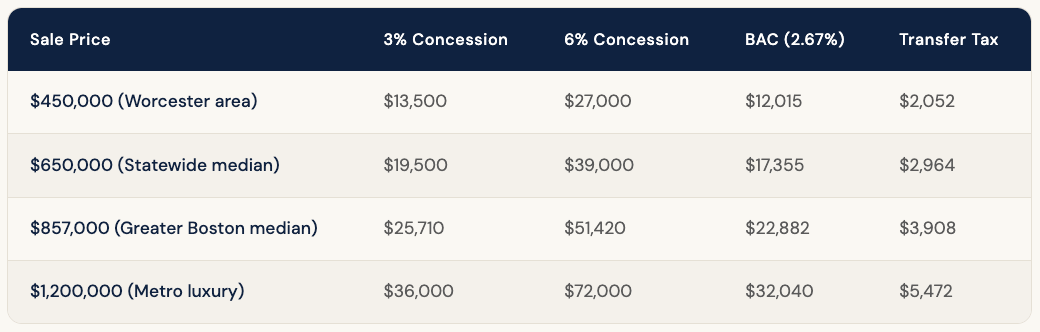
Massachusetts charges a deed excise (transfer) tax of $4.56 per $1,000 of sale price, rounded to the nearest $500. On a $650,000 sale, that's roughly $2,965 paid by the seller. This is separate from any concessions you offer.
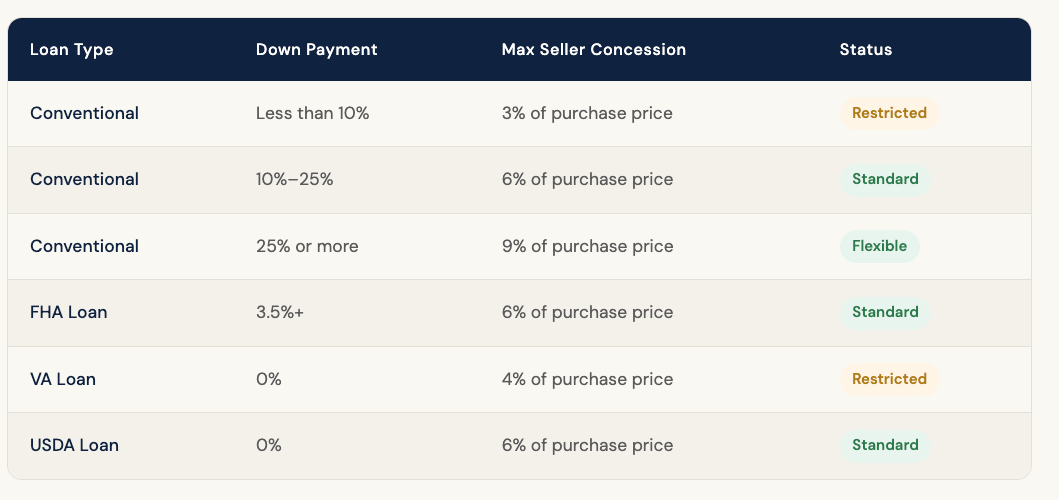
Loan-Type Concession Limits
Lenders cap how much sellers can contribute based on loan type and down payment. Exceeding these limits can create serious problems with financing approval:
Where the Massachusetts Market Stands Today
Before deciding whether, and how much, to concede, you need to understand your market position. Massachusetts in 2026 is a tale of two markets depending on where your home is located.

Statewide, homes are selling at approximately 99.9% of list price which means the market isn't dramatically buyer-friendly or seller-friendly overall. However, 40% of Massachusetts homes still sold above list price in March 2026, down from a year ago, suggesting the frenzy is moderating.
What This Means for Concessions
In Greater Boston and Cambridge, where inventory remains extremely constrained and demand is fierce, sellers have significant leverage and can minimize concessions. In Worcester, Springfield, and suburban markets that are rebalancing, offering concessions proactively can meaningfully strengthen your listing.
The days on market tell the story: Boston properties move in ~32 days. Worcester is even faster at ~24 days. If your home is sitting past 45 days, concessions become a smart competitive tool.
The NAR Settlement: How Buyer Agent Compensation Works Now
The most significant change affecting seller concessions is how buyer agent compensation (BAC) is now structured. Before August 2024, sellers were required to offer a set compensation amount to the buyer's agent when listing on the MLS. That's gone.
Now, buyer agent compensation is negotiated separately through each buyer's written agreement with their agent. As a seller, you can:
- Offer no buyer agent compensation whatsoever
- Offer a specific dollar amount or percentage as a concession within the purchase offer
- Negotiate compensation as part of offer review, comparing total net across different offers
- Split the buyer's agent commission partially with the buyer
How to Think About It
Your listing agent should prepare a net sheet for every offer received. An offer with no requested buyer agent compensation isn't automatically better than one that includes it; what matters is your total net proceeds and the strength of all terms combined. Always evaluate the whole picture.
When Should You Offer Concessions and When Shouldn't You?
Situations Where Concessions Help You
- Your home has been on the market for more than 30–45 days without offers
- A home inspection revealed issues that make buyers nervous about future costs
- Your home is priced near the top of its range and buyers need help with cash-to-close
- You're competing against new construction that offers built-in incentives
- You're targeting first-time buyers, who often have limited savings beyond their down payment
- The local market has shifted toward buyers with more inventory available
Situations Where You Can Hold Firm
- Multiple offer situations where buyers are competing against each other
- Your home is in a high-demand Boston or Cambridge neighborhood with under 30 days inventory
- Offers are already coming in at or above asking price
- You're in the $500K–$1.5M range where competition remains intense statewide
- The buyer requesting concessions has a weak overall offer with risky contingencies
The smart move: Rather than offering concessions upfront in your listing, let offers come in and negotiate concessions as part of counter-offer conversations. This gives you control and avoids leaving money on the table.
How to Structure a Concession Without Hurting Your Bottom Line
The biggest mistake Massachusetts sellers make is treating concessions as a price cut. They're not. And how you structure them matters enormously for your net proceeds and for the transaction's lender approval.
Always evaluate offers based on what you walk away with after concessions, commission, transfer tax, and closing costs. A $680,000 offer with a $10,000 concession often beats a $670,000 clean offer or vice versa, depending on your situation.
Ask the buyer's agent what loan type is being used, then confirm maximum allowed concessions before accepting any offer with seller credits. Agreeing to a concession that exceeds lender limits can derail your closing.
In Massachusetts, verbal agreements mean nothing. Any concession, including buyer agent compensation, must be clearly documented in the Purchase and Sale Agreement. The amount, purpose, and conditions should all be spelled out explicitly.
When buyers request a $15,000 concession, one strategy is to counter at a price that's $15,000 higher with the concession included, keeping your net the same while solving the buyer's cash-to-close problem. Your attorney can help structure this correctly. Keep in mind, the property will have to appraise at the higher price.
If closing costs end up being lower than the agreed credit, the unused portion does not come back to you. Work with your agent and the buyer's lender to ensure credits are sized appropriately so nothing is wasted.
Real Concession Scenarios for Massachusetts Sellers
Let's look at what concessions actually cost on typical Massachusetts home sales at different price points in 2026:
Common Questions
Massachusetts Seller Concession FAQs
Are seller concessions taxable income to the buyer?
Generally, seller concessions used toward closing costs are not considered taxable income to the buyer. However, tax treatment can vary depending on how concessions are structured. Always recommend your buyer consult a tax professional for their specific situation.
Do seller concessions affect the appraised value of my home?
Yes. Appraisers are aware of concessions and may adjust their valuation accordingly. Very large concessions can sometimes raise flags in the appraisal process. Your agent will help you structure offers to minimize appraisal risk.
Can I offer concessions without reducing my list price?
Absolutely. Seller concessions and list price are separate levers. Many sellers find it strategically better to hold firm on price and offer a closing cost credit, which solves the buyer's cash problem without lowering the sale price (which anchors future appraisals in your neighborhood).
What happens if the buyer's loan falls through after I've agreed to concessions?
Concessions are only enforceable if the transaction closes. If a deal falls apart, concession terms become moot. This is why it's critical to have a financing contingency clearly structured in your Purchase and Sale Agreement.
Is Massachusetts an attorney-closing state and does that affect concessions?
Yes. Massachusetts requires a licensed real estate attorney at closing. Attorney fees (~$1,300) are part of the buyer's closing costs, which is one reason buyer credits are so common here. Your attorney will review all concession terms in the Purchase and Sale Agreement before it's finalized.
Should I offer concessions in my listing, or wait for offers?
In most cases, it's better to wait for offers rather than advertising concessions upfront. Proactively advertising seller concessions can signal desperation and reduce your negotiating position. Let your agent advise based on current local demand for your specific price range and area.
Have questions? Let's chat!
508-365-7036 | [email protected]